Modern software teams are under constant pressure to ship faster without sacrificing reliability, security, or user satisfaction. That tension makes testing and continuous improvement central to sustainable development. This article explores how strong testing practices, feedback loops, and iterative refinement work together, why they matter across the software lifecycle, and how organizations can build a culture that consistently improves product quality.
Why Testing Is the Foundation of Reliable Software
Software development is often described as a process of building features, but in practice it is equally a process of reducing uncertainty. Every new requirement introduces assumptions: that the code works as intended, that it behaves correctly in edge cases, that it integrates with existing systems, and that it delivers value to users. Testing is the structured way teams challenge those assumptions before they turn into production failures.
At its core, testing is not merely a technical checkpoint performed near release. It is a quality strategy that begins as soon as requirements are discussed and continues long after deployment. When handled well, testing creates confidence at every stage of development. It helps developers change code without fear, gives product teams clearer visibility into release readiness, and provides organizations with a practical way to manage risk.
Effective testing starts with understanding that different kinds of tests answer different questions. Unit tests check whether small pieces of logic behave correctly in isolation. Integration tests validate that components communicate properly with databases, APIs, queues, or external systems. End-to-end tests examine whether full user flows work from beginning to end under realistic conditions. Performance, security, accessibility, and usability testing each add another dimension of quality that functional checks alone cannot cover.
What makes this especially important is that software defects are rarely limited to obvious bugs. A system may technically function while still failing users due to slow responses, confusing interfaces, inaccessible workflows, or unstable behavior under load. A mature testing approach expands the idea of quality beyond “it works on my machine” to include resilience, clarity, safety, and consistency in real-world use.
Testing also shapes architecture. Teams that invest in testability often produce better software design because code that is easy to test tends to be modular, loosely coupled, and easier to reason about. For example, if business logic is separated cleanly from presentation code and infrastructure concerns, developers can verify behavior more precisely and change one part of the system without unexpectedly breaking another. In this way, testing is not a passive activity performed after development; it actively influences how good systems are built.
Automation is one of the most transformative aspects of modern testing. Manual testing remains valuable, especially in exploratory work where human judgment uncovers subtle problems, but automated testing gives teams repeatable, scalable feedback. Once added to a continuous integration pipeline, automated tests can quickly detect regressions every time code is committed. This shortens feedback loops and prevents defects from accumulating unnoticed.
Still, more tests do not automatically mean better quality. Poorly designed test suites can become slow, brittle, and expensive to maintain. Teams sometimes overinvest in end-to-end tests that are hard to debug while neglecting fast, reliable unit and integration coverage. Others write tests that merely confirm implementation details rather than meaningful business outcomes, making refactoring unnecessarily difficult. The goal is not to maximize the number of tests but to create a balanced portfolio that produces useful, trustworthy feedback.
To make that possible, teams should be guided by several practical principles:
- Test early: Quality risks should be discussed during planning, not discovered only at release time.
- Test based on risk: Critical business logic, security-sensitive features, and high-traffic user journeys deserve deeper coverage.
- Keep feedback fast: Developers are more likely to act on test results when they arrive quickly and clearly.
- Design for maintainability: Tests should evolve with the codebase and remain understandable to the team.
- Combine automation and exploration: Automated checks catch known problems efficiently, while human testers discover unknown ones.
These principles matter because software quality is cumulative. Every rushed release, every unverified edge case, and every ignored warning introduces hidden cost. Defects in production are rarely isolated events; they generate customer frustration, support burden, emergency fixes, and loss of trust. In regulated or high-stakes environments such as finance, healthcare, or infrastructure, the consequences can be far greater. Testing is therefore not a luxury or a bureaucratic formality. It is a disciplined investment in reliability, reputation, and long-term delivery speed.
Another important shift in modern development is the idea that testing belongs to the whole team, not just dedicated QA specialists. Developers, testers, product managers, designers, operations engineers, and security professionals all contribute to quality from different angles. Product managers clarify expected outcomes and edge cases. Designers help uncover usability and accessibility concerns. Operations teams identify deployment and observability issues that influence reliability in production. Shared ownership prevents quality from becoming a handoff problem.
This broader view aligns with a more comprehensive understanding of software improvement. Strong testing can identify whether the system behaves correctly today, but continuous improvement asks a larger question: how can the team make the system, the process, and the product better over time? That transition from verification to learning is where high-performing software organizations distinguish themselves.
For additional perspective on how iterative quality practices strengthen development workflows, see Testing and Continuous Improvement in Software Development.
How Continuous Improvement Turns Testing Into Long-Term Advantage
Testing becomes truly powerful when it feeds a culture of continuous improvement. In many organizations, testing is treated as a gate: code is written, checked, and either approved or rejected. While this has value, it captures only part of what quality work can achieve. The deeper opportunity lies in using test results, production insights, and team retrospectives to improve not just the current release but every future release as well.
Continuous improvement in software development is the deliberate practice of learning from outcomes and turning that learning into better code, better processes, and better decisions. It depends on the understanding that software systems are never static. User expectations shift, dependencies change, infrastructure evolves, and new requirements introduce new risks. Teams that improve continuously accept change as normal and create mechanisms to respond intelligently rather than reactively.
One of the most practical ways this happens is through feedback loops. A test suite provides one feedback loop by revealing defects during development. Code review offers another by catching design problems, unclear logic, and maintainability issues. Monitoring and observability extend the loop into production by showing how the software behaves under real usage. Customer support tickets, analytics data, and user research complete the picture by connecting technical performance with lived user experience.
The effectiveness of continuous improvement depends on how quickly and honestly a team learns from these sources. If tests fail but no one investigates root causes, there is no improvement. If incidents happen but postmortems focus on blame instead of system weaknesses, learning is limited. If metrics exist but are disconnected from product goals, teams may optimize what is easy to measure rather than what matters. Continuous improvement requires disciplined reflection and action.
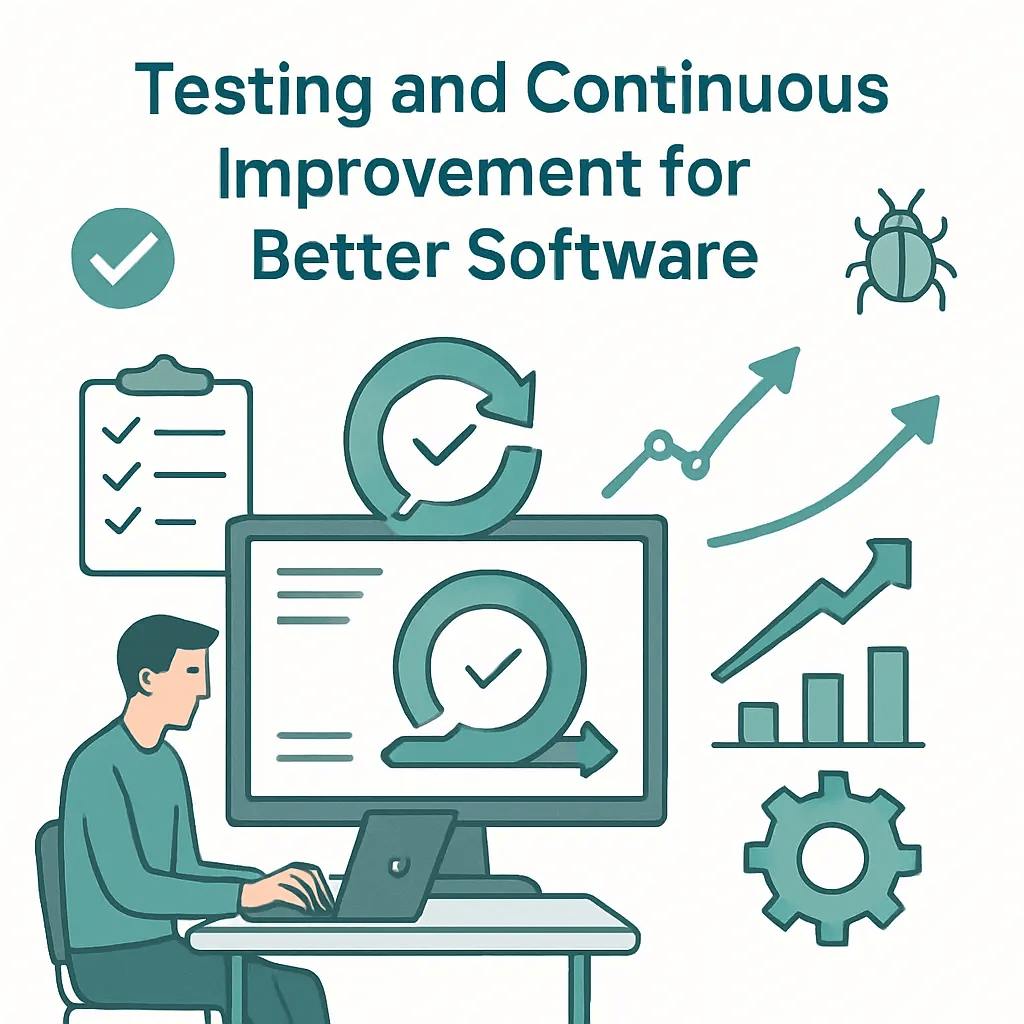
A strong improvement cycle often follows a predictable pattern:
- Measure: Collect data from tests, pipelines, incidents, performance metrics, and user behavior.
- Interpret: Identify trends, recurring failures, bottlenecks, and hidden risks.
- Prioritize: Decide which issues most affect product quality, delivery speed, or customer satisfaction.
- Improve: Adjust code, tests, architecture, workflow, or communication practices.
- Validate: Confirm that the change actually solved the problem and did not create new ones.
This cycle sounds simple, but its power lies in repetition. Over time, small improvements compound. A team may first stabilize flaky tests, then streamline build times, then improve deployment safety, then reduce mean time to recovery after incidents. None of these changes alone transforms an organization, but together they produce a development environment that is faster, calmer, and more reliable.
One area where continuous improvement is especially valuable is defect prevention. Many teams spend most of their quality effort detecting bugs after they are introduced. More advanced teams ask why those bugs were possible in the first place. Was the requirement ambiguous? Was the code too tightly coupled? Was a critical scenario missing from automated coverage? Was there pressure to bypass review? By addressing recurring root causes, teams reduce future defect volume instead of simply processing failures more efficiently.
This is why retrospectives and incident reviews matter. When conducted well, they reveal patterns that ordinary delivery work can obscure. Perhaps deployment failures happen because environment configurations drift. Perhaps customer-reported bugs cluster around one aging subsystem that resists automated testing. Perhaps accessibility issues recur because they are not considered during design. These insights help teams target structural improvements rather than just patch visible symptoms.
Continuous improvement also changes how organizations think about delivery speed. There is a widespread misconception that testing slows down development. In the short term, writing tests, reviewing code carefully, or pausing to analyze incidents can indeed seem slower than simply pushing features forward. But over time, the absence of these practices creates rework, instability, and fragile releases that dramatically reduce throughput. Fast development is not the same as hurried development. Sustainable speed comes from reducing the friction caused by defects, uncertainty, and manual recovery work.
Modern delivery practices such as continuous integration and continuous delivery support this model by making improvement operational. Continuous integration encourages developers to merge small changes frequently and validate them automatically. Continuous delivery ensures that software remains in a deployable state through repeatable pipelines and consistent verification. Together, these practices reduce the risk of large, hard-to-diagnose failures and make learning more immediate.
However, tooling alone is not enough. A team can have advanced pipelines and still struggle if the surrounding culture discourages transparency or experimentation. Continuous improvement requires psychological safety: people must feel able to raise concerns, admit mistakes, and question ineffective processes. If failures are punished, teams hide them. If metrics are used only to assign blame, data quality declines. Improvement thrives where evidence is welcomed and learning is rewarded.
Leadership plays a critical role here. Managers and technical leads influence whether testing and improvement are treated as strategic priorities or expendable overhead. When delivery plans leave no room for refactoring, test maintenance, or technical debt reduction, quality gradually erodes. By contrast, when leaders recognize that quality work enables future delivery, teams are more likely to make prudent investments before problems become crises.
There is also an important business dimension to continuous improvement. Testing and quality practices should not be isolated from organizational outcomes. Reliable software reduces churn, protects brand trust, and lowers operational cost. Better observability improves incident response and supports service-level commitments. Faster feedback helps teams validate product ideas earlier and avoid building the wrong thing. In this sense, testing and improvement are not merely engineering concerns; they are business capabilities.
To make continuous improvement practical, organizations can focus on a few high-leverage habits:
- Track quality trends over time: Look beyond single releases to understand defect patterns, flaky tests, and operational pain points.
- Invest in observability: Logs, metrics, and traces help connect code changes to production behavior.
- Review incidents systematically: Treat outages and failures as learning opportunities, not isolated mistakes.
- Refine test strategy regularly: As the architecture changes, coverage priorities should evolve as well.
- Protect time for maintenance: Test reliability, refactoring, and technical debt work are essential to long-term improvement.
- Link quality to user outcomes: The ultimate measure of improvement is whether the software serves people more effectively.
As teams mature, they often discover that continuous improvement is less about a single methodology and more about disciplined curiosity. They ask not only “Did this release pass?” but also “What did we learn?”, “What slowed us down?”, “What risk are we carrying forward?”, and “How can the next change be safer than the last?” Those questions transform testing from a defensive activity into a strategic source of knowledge.
That perspective is especially useful in complex systems where certainty is impossible. No test suite can prove the absolute absence of defects, and no process can eliminate every failure. But organizations can still become consistently better at detecting issues early, responding effectively, and designing systems that are easier to evolve. Continuous improvement accepts imperfection while refusing complacency.
For a complementary discussion of how testing and iterative refinement support software excellence, refer to Testing and Continuous Improvement in Software Development.
Ultimately, the strongest software teams treat testing as the mechanism that reveals truth and continuous improvement as the discipline that acts on it. Testing shows where quality stands; improvement determines whether quality rises over time. When combined, they reduce risk, strengthen architecture, speed delivery in a sustainable way, and create better user experiences. For any organization building software seriously, this is not optional process overhead but a durable competitive advantage.